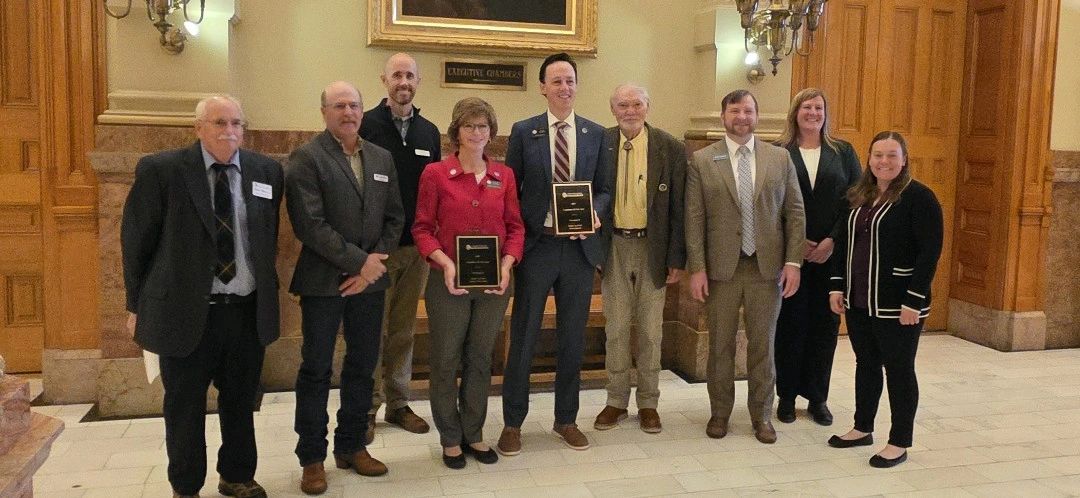
When Abbey Grey arrived at the Colorado State Capitol on a snowy May morning, the state’s first Conservation Legislative Day was already underway. Grey, executive director of the Colorado Association of Conservation Districts (CACD), had been delayed by car trouble and a late-spring storm. But Nikki Brinson of the Colorado Department of Agriculture (CDA) had already set up the West Foyer and had begun connecting conservation district representatives with lawmakers. It was an immediate demonstration of the collaboration between CACD and CDA that proved essential to Colorado’s first Conservation Legislative Day.

Bringing district representatives and lawmakers together was no small feat that morning. Poor road conditions complicated representatives’ travel to the Capitol, while floor votes and committee work competed for elected officials’ attention on the final day of the session. Despite those obstacles, representatives from 10 conservation districts attended, and legislators made time to engage with them. Some who stopped for breakfast burritos stayed for conversations about forest health, water, working lands and the challenges facing Colorado farmers, ranchers and resource professionals.
Still, approaching elected officials seemed intimidating for some district representatives. As the morning unfolded, however, participants realized they did not need to sound like lobbyists or policy specialists. Authority came from knowing their communities, farms and ranches, local natural resources and conservation needs. By morning’s end, that realization had changed their outlook.
“When everyone left the Capitol that day,” Grey recalled, “they left with an energy of, ‘My work means something.’”
That confidence was what Grey and Brinson, director of the Colorado State Conservation Board program within CDA, had hoped to build. The goal was for legislators to connect conservation policy with the people carrying it out and for district representatives to recognize that first hand knowledge of conditions on the ground could help shape decisions affecting locally led conservation.
The idea for Conservation Legislative Day took shape after Grey and Brinson traveled to Washington, D.C., where face-to-face discussions produced progress on issues they had not expected to resolve.
“If we can move mountains in Washington,” Grey said, “our districts can do that in Colorado. We need to help them see how powerful their voice can be.”
The experience left Grey and Brinson determined to make conservation districts more visible at the Capitol. Although district representatives had participated in broader agricultural events there, conservation district priorities could be lost among competing messages.
“We quickly realized there’s a need for conservation to be identified individually and for our districts to be seen,” Grey said.
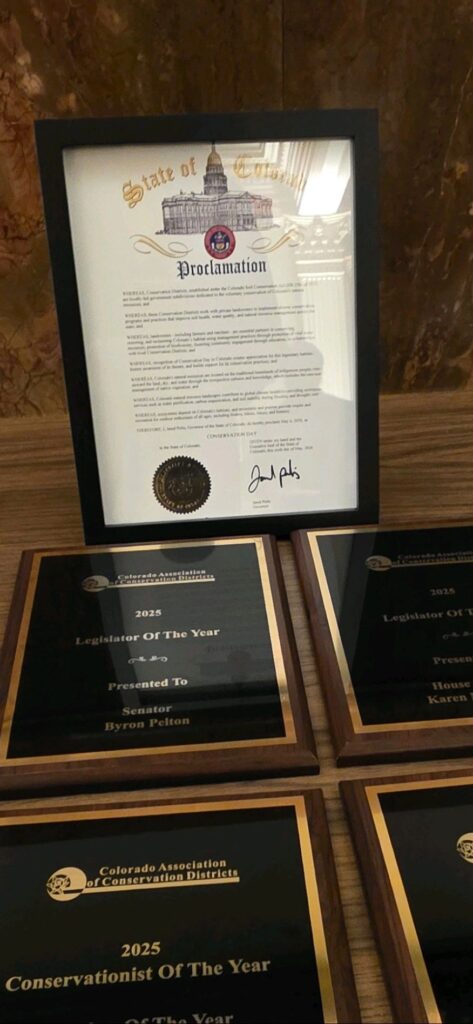
Grey and Brinson began planning in March 2026. To draw attention to the event, they secured a gubernatorial proclamation designating May 6 as Conservation Day in Colorado. The date marked the anniversary of Colorado’s original Soil Conservation Act, and the proclamation recognized conservation districts and their stewardship work. Brinson gathered the historical and program information for the proclamation request, while Grey coordinated logistics for the day.
The organizers structured the gathering to foster direct interaction between district representatives and lawmakers. Participants were encouraged to schedule meetings, bring annual reports and local materials and distribute fact sheets documenting conservation impacts across Colorado. Grey and Brinson matched lawmakers with representatives from their districts and helped establish common ground by highlighting local projects
CACD also built recognition of its three 2025 Legislators of the Year into the day. Senate Agriculture Committee Chair Dylan Roberts, House Agriculture Committee Chair Karen McCormick and Sen. Byron Pelton all stepped away from legislative business to accept their awards and speak with district representatives. Their participation showed Grey that the awards were meaningful to them and helped draw other lawmakers to the gathering. CDA and CACD have distinct roles and authorities within the partnership. As a state agency, CDA cannot lobby or urge legislators to support particular bills or funding decisions. It can keep districts in statutory compliance, administer operational and technical assistance funding, collect impact data and explain how public funds are used.
CACD, an independent association representing conservation districts, can advocate for district priorities and lobby for funding and legislation. In practice, that division of roles shaped the Legislative Day: CDA supplied data, program knowledge and support; CACD organized the event and communicated district priorities; and representatives contributed constituent voices and knowledge of local conditions.
Grey summarized the partnership succinctly: “She’s capacity, and I’m policy.” “There is no competition,” Brinson added. “We’re there for our districts, and that’s our sole mission and goal.”
At the Capitol, once introductions were made, district representatives described multigenerational ranches, watershed work, forest projects and how legislative decisions affected their communities. When lawmakers asked questions, the representatives began speaking more freely about what worked, what did not and what support would make a difference.
“The more they talked about their local community or their own farm or ranch,” Brinson said, “the more comfortable they were. They’re the subject matter experts.”
Grey saw the same shift. “When you start hearing them say they’re fifth-generation ranchers, “she said, “you know they’ve opened up.”
Two lawmakers from metropolitan areas without conservation districts also joined the conversation and learned how district projects affect their constituents through shared water, natural resources and statewide policy. Both vote on measures affecting agricultural producers, underscoring the value of engaging lawmakers beyond areas directly served by conservation districts.
For Grey, those personal exchanges accomplished what white papers and written summaries could not.
“For the districts to tell their story is completely different,” Grey said. “Now legislators have a face. They have a name.”
Grey and Brinson candidly acknowledge that the inaugural event was an experiment. “We had no idea what we were doing,” Brinson admitted. “We were kind of flying by the seat of our pants.”
Although snow limited attendance and uncertainty over the proclamation delayed publicity, the smaller gathering allowed for sustained discussion and gave participants a meaningful first experience at the Capitol.
For other states considering a Conservation Legislative Day, Colorado’s lesson is to begin without waiting for a perfect blueprint: choose a date, secure space through a legislative contact, provide useful data and local materials and facilitate introductions. A proclamation can add visibility, but it is not essential.
“Just begin,” Grey advised. “Pick a day and be committed to it.” “Being there is half the battle,” Brinson added.
Brinson and Grey plan to make Conservation Legislative Day an annual event, with additional practical guidance for participants on engaging with lawmakers, from scheduling meetings and preparing materials to speaking confidently about local conservation priorities. They hope the day will become a tradition that lawmakers and conservation districts anticipate each year. For Brinson, the first Legislative Day also affirmed the value of the complementary roles CDA and CACD played. “I think our organizations do better work together,” she said. “Abbey and I do not agree on everything … but we are a united front for Colorado’s conservation districts.” By the time the gathering ended, district representatives had gained more than new contacts at the Capitol. They had put faces, names and firsthand experience behind conservation policy. And they left with a conviction that could shape every Legislative Day to come: The people who know the land best also belong in the rooms where decisions about its future are made.