Across the Midwest, farmers, conservation districts and state agencies face a common challenge: there are not enough trained conservation planners to meet growing demand for soil health, water quality and habitat improvements on private lands. Because nearly every major conservation effort begins with field-level design, many producers cannot participate in federal and state conservation initiatives until a workable approach is tailored to their land and management goals.
Illinois felt the strain on conservation staffing as multiple pressures converged: Conservation Reserve Program (CRP) demands remained heavy, nutrient loss reduction efforts required stronger field support, and landowners increasingly needed specialized assistance to move approved practices into implementation.
“We had the Gulf hypoxia issue, nutrient loss reduction strategy pressures, and at the same time, NRCS could see the growing workload,” said Elliot Lagacy, supervisor of the Bureau of Land and Water Resources at the Illinois Department of Agriculture (IDOA). “The question quickly became how to build staffing capacity fast enough to meet the demand already coming toward us.”
State natural resource leaders recognized that meeting conservation demands would require more trained people in the field. In response, IDOA, the state’s soil and water conservation districts (SWCDs), and the Natural Resources Conservation Service, or NRCS, created the Conservation Technical Assistance initiative, a training strategy designed to advance local professionals toward Level 1 conservation planner certification.
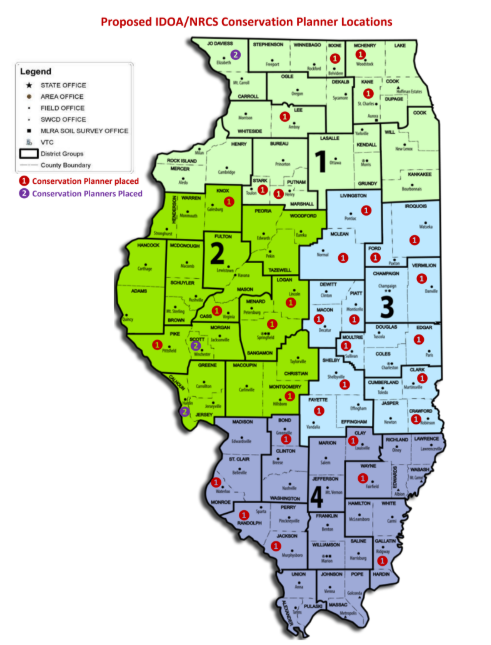
That partnership quickly moved from concept to funding, with support from the Office of Governor J.B. Pritzker. In 2022, Illinois conservation officials combined $3.5 million from IDOA nutrient reduction funding with NRCS’s $9.8 million in federal support to launch a $13.3 million pilot program that placed 40 conservation planners across the state over three years.
The goal was to increase the number of Level 1-qualified professionals through a structured pathway of classroom instruction, online coursework and field mentoring. New planners begin with NRCS’s nine- step planning process and core conservation principles, then work directly with experienced NRCS and SWCD staff—joining mentors on farm visits, conducting resource inventories, and helping develop recommendations that translate conservation science into practice.
The planners are retained through local soil and water conservation districts while serving inside NRCS field offices, a structure that keeps conservation work close to producers and allows them to help landowners address resource concerns and prepare strategies that meet NRCS standards.
“Their job is to become qualified and certified to provide technical assistance through NRCS programs,” Lagacy said. “What they bring is technical service directly to landowners across the state.”
Once certified, those planners handle much of the foundational planning work—resource inventories, field visits, draft plans, and producer contact—allowing more highly trained staff to focus on complex decisions and contract review. “Having another capable body in the office helps provide support for everyone,” Lagacy said.
Beyond immediate staffing support, Illinois deliberately built what officials describe as a conservation workforce pipeline rather than a traditional hiring initiative. “We always promoted it as a pipeline,” said Brian Rennecker, natural resources division manager at IDOA. “Once these employees go through NRCS metrics, they become qualified not only for SWCD positions but also for NRCS and other conservation employers.”
The effort links Level 1 certification to funding, field placement and long-term career advancement. New planners entered positions with the expectation of obtaining certification. “We incentivize these planners to get Level 1 done,” Lagacy said. “As soon as they complete it, they see a pay increase.” Additional pay increases follow as staff attain higher certification levels.
From the beginning, Rennecker said the first planning conversations with NRCS were highly practical. “It really started as a whiteboard exercise—looking county by county at where gaps were and where new planners would have the greatest impact,” he said. Instead of distributing planners evenly, Illinois placed them where staffing shortages and conservation workload overlapped most acutely.
The original plan called for gradual hiring over three years, but early recruitment moved faster than anticipated. “We thought we’d hire 10 the first year, 20 the second, then finish out the third year,” Rennecker said. “But hiring went so well, we decided to hire all 40 the first year.”
The workforce pipeline is proving stronger than originally expected. Although current staffing fluctuates around the low 30s, more than 50 individuals have moved through the Illinois system since the program began in 2022, with many certified Level 1 planners advancing into permanent conservation positions across districts, agencies and partner organizations.
For other states, Lagacy and Rennecker said the first requirement is an effective state-federal partnership.
“If another state wants to do this, the first requirement is simple: strong communication between the state department and the NRCS state office,” Lagacy said.
A second lesson, they said, is that workforce expansion works best when state agencies and NRCS begin with a clearly shared conservation objective.
“In Illinois, the shared objective centered on CRP delivery and nutrient loss reduction,” Rennecker said. “In another state, the driver may be EQIP backlog, grazing systems, drainage water management, or habitat planning—but both partners must be solving the same problem.”
A third lesson quickly emerged: none of it works without stable funding.
“You can’t do any of this if you don’t know what funding looks like,” Rennecker said. “But you have to go through the steps to figure out what that funding is going to look like.”
In Illinois, that meant working backward from salary, benefits, and payroll before deciding how many planners the model could support, then matching those positions to areas where CRP workload was highest.
Taken together, Illinois’ clearest lesson is that conservation capacity grows best when people are developed as carefully as programs are designed. The planners now working across the state are addressing immediate resource concerns while becoming the next generation of district staff, NRCS employees, and conservation professionals.
For other states facing similar shortages, Illinois demonstrates that when state and federal partners align funding, identify shared conservation priorities, and invest deliberately in training, they can expand technical capacity in ways that continue paying dividends beyond a single grant cycle—one planner and one farm at a time.